
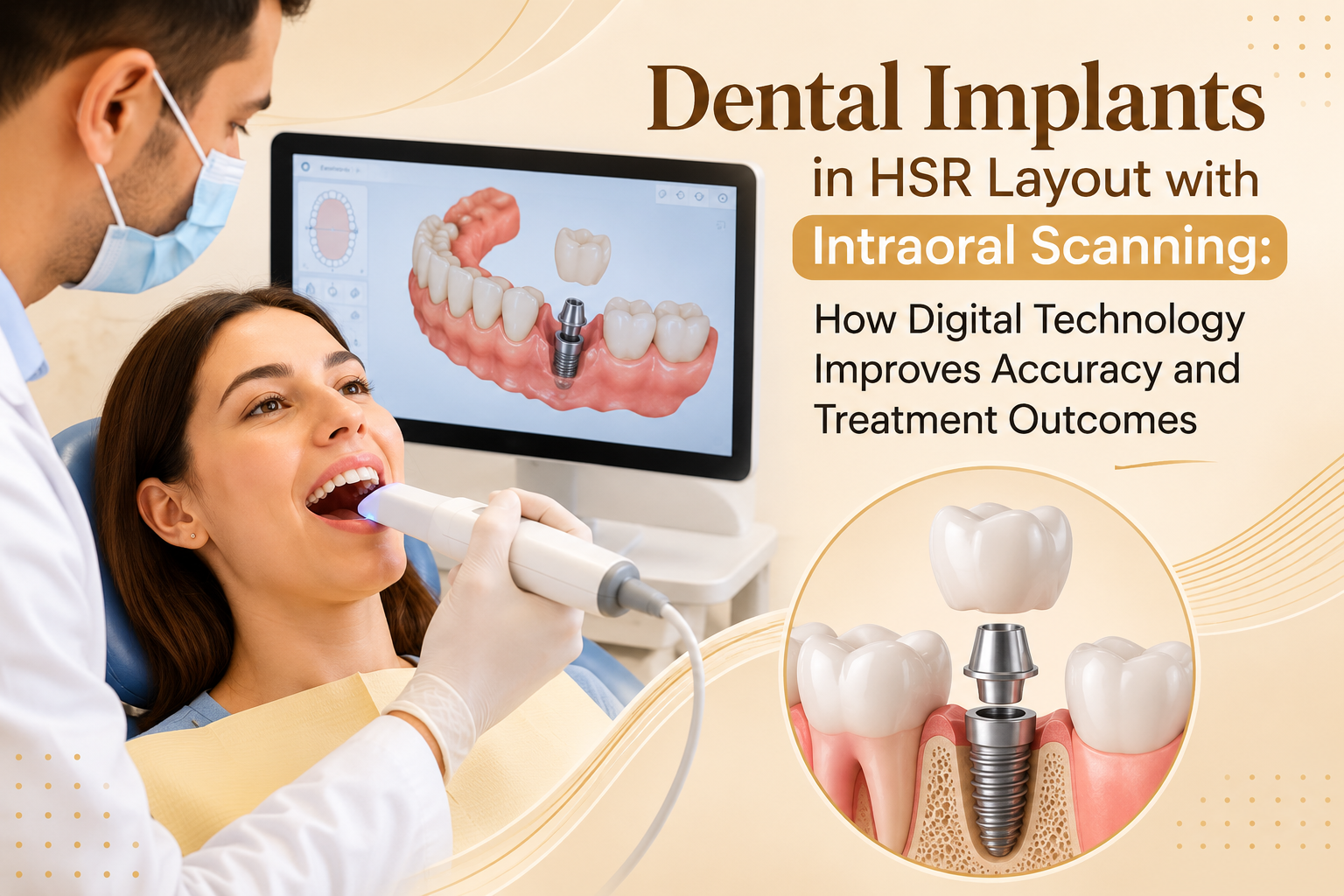
Dental implant treatment is one of the most reliable and long-term solutions for replacing missing teeth. Dental implants in HSR Layout with intraoral scanning are now increasingly preferred because they offer higher precision, improved comfort, and more predictable treatment outcomes compared to traditional methods.
This advanced digital approach helps dentists restore missing teeth with better accuracy, improved aesthetics, and long-term stability. However, successful dental implant treatment depends on proper diagnosis, precise planning, and the use of modern digital dentistry tools working in coordination.
At Dr SS Dental Care, HSR Layout, Bangalore, advanced digital technologies like intraoral scanning are integrated into every stage of implant treatment to improve planning accuracy and patient outcomes.
What Is Intraoral Scanning in Dental Implant Treatment?
Intraoral scanning for dental implants in HSR Layout is a modern digital technique used to capture a highly accurate 3D image of the teeth, gums, and surrounding oral structures using a compact handheld scanner.
Unlike traditional impression methods that rely on physical moulds which can be messy, uncomfortable, and prone to distortion intraoral scanners create a precise digital model of the patient’s mouth instantly. There is no waiting for material to set and no risk of the impression shifting before it reaches the laboratory.
This digital data is then used across multiple stages of treatment, including:
- Dental implant planning and positioning
- Designing implant crowns and bridges
- Creating customised surgical guides for accurate placement
- Evaluating bite and occlusal alignment
- Digital prosthetic fabrication
These capabilities make intraoral scanning a central component of digital dental implants in HSR Layout Bangalore, and a key reason why outcomes at technology-driven clinics continue to improve.
Why Intraoral Scanning Is Important for Dental Implants
Dental implants require a high degree of clinical precision. Even minor errors in impression-taking or crown design can affect bite alignment, implant stability, and long-term success. A poorly fitting crown places uneven stress on the implant post, which can compromise osseointegration and shorten the life of the restoration.
That is why modern implant dentistry in HSR Layout increasingly depends on intraoral scanning technology. Digital scanning eliminates the most common sources of clinical error material distortion, patient movement during impression-taking, and manual adjustments during lab fabrication.
Key clinical benefits include:
- Highly accurate digital impressions with sub-millimetre precision
- Better coordination between the dentist and the dental laboratory
- Reduced risk of human error during planning and fabrication
- Improved implant placement through better spatial analysis of bone and adjacent teeth
- Faster and more efficient workflow from diagnosis to final crown delivery
These advantages have established intraoral scanning as a standard part of advanced dental implant technology in Bangalore clinics that prioritise clinical quality and patient safety.
How Intraoral Scanning Improves Dental Implant Accuracy
One of the biggest advantages of intraoral scanning dental implants in HSR Layout Bangalore is its ability to improve precision at every stage of the treatment process, not just at impression-taking.
- Accurate Digital Impressions
The handheld scanner captures precise 3D details of oral structures in real time. This level of accuracy directly translates to a better-fitting implant crown and eliminates the distortions commonly seen with traditional impression materials.
- Better Treatment Planning
With a complete digital model of the mouth, dentists can evaluate jawbone structure, available space, and proximity to neighbouring teeth more effectively. This leads to safer implant positioning and more predictable long-term outcomes.
- Improved Crown Fit
Digital design tools allow the prosthetic crown or bridge to be fabricated with exceptional accuracy. The result is a restoration that fits correctly on first placement, significantly reducing the need for post-treatment chair-side adjustments.
- Reduced Clinical Errors
Traditional impression materials can shrink, shift, or distort between the time of taking the impression and pouring the mould at the laboratory. Digital scanning removes this variable entirely, delivering consistent and reliable data every single time.
How Intraoral Scanning Improves the Patient Experience
Many patients feel anxious about dental impressions, particularly those who experience a strong gag reflex or sensitivity to the materials used in conventional moulds. Intraoral scanning significantly improves comfort and reduces overall appointment time, making the treatment experience far less stressful.
Patient benefits include:
- No messy impression material placed in the mouth
- Quick, painless scanning that typically takes only a few minutes
- Greatly reduced or eliminated gag reflex during the process
- Fewer dental visits required across the full treatment timeline
- Faster treatment planning and quicker delivery of the final restoration
This is why patients increasingly search for painless dental implant treatment in HSR Layout using digital dentistry. When the process is more comfortable, patients are more likely to complete their full treatment plan and achieve the long-term outcome they are looking for.
Step-by-Step Process of Intraoral Scanning for Dental Implants
Step 1 — Digital Scan
A compact handheld intraoral scanner is moved gently around the mouth, capturing a real-time 3D image of the teeth, gums, and implant site without any physical mould material.
Step 2 — Digital Model Creation
The scan data is instantly converted into a detailed virtual 3D model that the dentist can rotate, zoom, and analyse from every angle on-screen.
Step 3 — Implant Planning
Using the digital model, the dentist studies bone density, available space, and bite alignment to plan the ideal implant position before any procedure begins.
Step 4 — Surgical Guide Preparation (if required)
A customised surgical guide may be 3D printed or milled based on the scan data, ensuring the implant is placed at the exact planned angle and depth during surgery.
Step 5 — Final Restoration
After the implant integrates with the jawbone, a custom crown is digitally designed and fabricated for a precise fit, natural appearance, and long-term function.
This complete digital workflow is the standard for modern digital dentistry in HSR Layout Bangalore, delivering consistent and predictable results across all types of implant cases.
Intraoral Scanning vs. Traditional Dental Impressions
| Feature | Traditional Impressions | Intraoral Scanning |
| Method | Physical mould material | Digital 3D scan |
| Comfort | Can cause discomfort | Comfortable and quick |
| Accuracy | Risk of distortion | Sub-millimetre precision |
| Speed | Slower process | Faster workflow |
| Error management | Manual corrections needed | Digital precision throughout |
This comparison explains clearly why digital impressions for dental implants in HSR Layout are now the preferred choice among both clinicians and patients who want the best possible outcome.
Role of Intraoral Scanning in Long-Term Implant Success
Long-term implant success depends on far more than just the surgical placement itself. Proper bite alignment, accurate crown fit, and balanced occlusal loading all play a critical role in how well an implant performs over the years.
Intraoral scanning supports long-term success by:
- Ensuring precise prosthetic design from the very first scan
- Improving bite balance so no single implant bears excessive load
- Reducing mechanical stress on the implant post and surrounding bone
- Enhancing overall durability and functional performance of the restoration
This directly improves outcomes for patients searching for the best dental implants near me in HSR Layout who want results that last.
Who Can Benefit from Intraoral Scanning for Dental Implants?
This technology is suitable for a wide range of patients and clinical situations, including:
- Single tooth replacement following extraction or trauma
- Multiple missing teeth requiring individual implants
- Full mouth rehabilitation with implant-supported restorations
- Implant-supported bridges replacing several consecutive teeth
- Patients seeking faster treatment timelines with fewer appointments
- Patients with a strong gag reflex who struggle with traditional impressions
Frequently Asked Questions
- Is intraoral scanning necessary for dental implants?
It is not mandatory in every case, but it significantly improves accuracy, comfort, and the overall predictability of treatment outcomes across all implant types. - Is digital scanning better than traditional impressions?
Yes. Digital scanning is more accurate, more comfortable for the patient, and faster which benefits both the patient and the clinical team throughout treatment. - Is dental implant treatment painful?
The procedure is performed under local anaesthesia and is generally well-tolerated. Most patients report only minimal discomfort during and after the procedure. - How long does dental implant treatment take?
Treatment duration depends on bone health and case complexity. Digital planning helps reduce overall treatment time by improving first-visit accuracy. - What are the main advantages of intraoral scanning for implants?
Improved accuracy, reduced clinical errors, enhanced patient comfort, fewer appointments, and better long-term implant success rates.
Conclusion
Dental implants in HSR Layout with intraoral scanning represent a clear step forward in modern implant dentistry. By replacing conventional impression methods with precise digital scanning, dentists can deliver faster, safer, and more accurate restorations with a noticeably better patient experience at every stage.
If you are considering dental implant treatment in Bengaluru, choosing a clinic that uses digital dentistry tools can make a meaningful difference to the quality and longevity of your outcome.